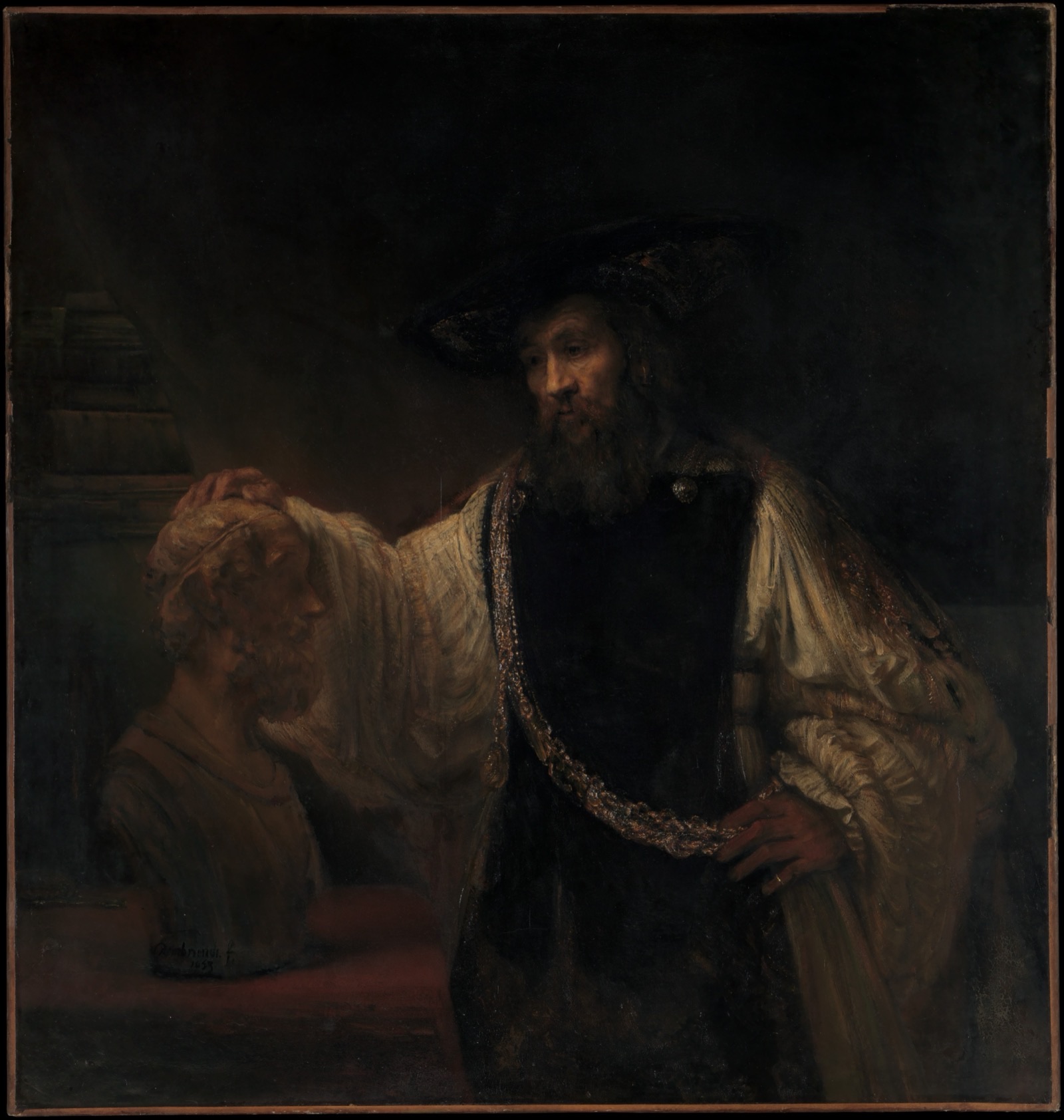
Aristotle with a Bust of Homer, Rembrandt (1653)
Post-WWII, the U.S. dollar became the world's reserve currency and the monetary foundation of American hegemony. Businesses wanted dollars to price trade, governments wanted dollars to borrow, and foreign banks wanted dollar exposure outside the United States, free from domestic banking regulations and reserve requirements.
Enter the Eurodollar system: dollar-denominated credit was created, lent, and circulated offshore. Banks took those dollars in and lent them out again, multiplying dollar credit no American regulator controlled. A parallel monetary regime had formed.
Tokens produced by the leading foundation-model labs are the pseudo-currency of the AI age. They are the unit in which intelligence is measured, priced, and sold. They are both input and output. They are both a unit of context and a unit of work. And they can be assembled into larger units of language, code, reasoning, and action.
The best labs mint the most valuable tokens. Today, tokens from the leading American labs resemble postwar dollars: issued by the dominant power, backed by the world's deepest capital and compute markets, and demanded across the rest of the world.
That demand exceeds official distribution. Access remains constrained by geography, price, export controls, and the policies of the labs themselves.
Everyone wants access to American tokens. Through resellers and proxy APIs, that access is being routed offshore and sold into markets the labs do not directly serve.
Anthropic charges fifteen dollars for a million Claude tokens; on Taobao the same tokens go for one or two. The spread is the price of jurisdiction: an account the lab can close. What the reseller sells is American intelligence with that jurisdiction stripped away.
AI Eurodollars are offshore, token-denominated claims on American intelligence: redeemable for American model output, yet held and traded abroad. The tokens are still minted in America, but their circulation increasingly is not.
A model gives itself away every time it answers. Each reply is a sample of the function behind it, and a proxy that logs enough of them is copying the model one query at a time. In February, Anthropic said DeepSeek, Moonshot, and MiniMax had distilled their own models from sixteen million Claude exchanges run through fake accounts; by June it was telling the Senate that Alibaba's Qwen lab had done the same at nearly twice the scale. Tokens sold as inference come back as a rival's training data.
The analogy is imperfect: a Eurodollar remained a claim denominated in dollars; a distilled model is an approximation of the American original, not the same instrument.
There is a certain paradox in this. The Eurodollar market dramatically expanded the reach of America's monetary experiment. Dollars escaped the American banking system and became the financial infrastructure of postwar globalization. Intelligence may follow: the labs lose their grip on how their models spread even as those models become the standard the rest of the world builds on. Losing control of circulation and winning the standard can be the same event, for now.
How does the AI Eurodollar market end? Does an American crackdown close the offshore routes, chip by chip and account by account? Do other states mint their own currency, an AI "de-dollarization" that frees them from depending on American models? Or does it evaporate when inference becomes too cheap to meter?
America has done this before. It invented the semiconductor and shipped its manufacture offshore as drudge work; the drudges climbed, and the best chips in the world are now made in Taiwan, not America. By copying American models, labs abroad are learning to make them, compete with their makers, and outgrow the controls meant to contain them.
Disclaimer: This post is provided for informational purposes only and does not constitute financial, investment, legal, tax, or other professional advice, or an offer or solicitation to buy or sell any asset or security. The views expressed are solely my own and do not necessarily represent those of Ritual or its affiliates. Conduct your own research and consult your professional advisers before making any investment decision.
Niraj Pant is the co-founder of Ritual and a former partner at Polychain Capital.